Private enterprise - Private clinic in the center
Dr. Ophthalmologist András Albert and his wife, dr. Allergist Albert Kinga decided four years ago that they wanted to continue their independent activities in their own clinic. This is how they embarked on the investment that created the first privately owned, full-fledged art block and clinic in Sepsiszentgyörgy.
Háromszék daily newspaper: Money, market, business, Wednesday, November 18, 2020 - Csaba Ferencz
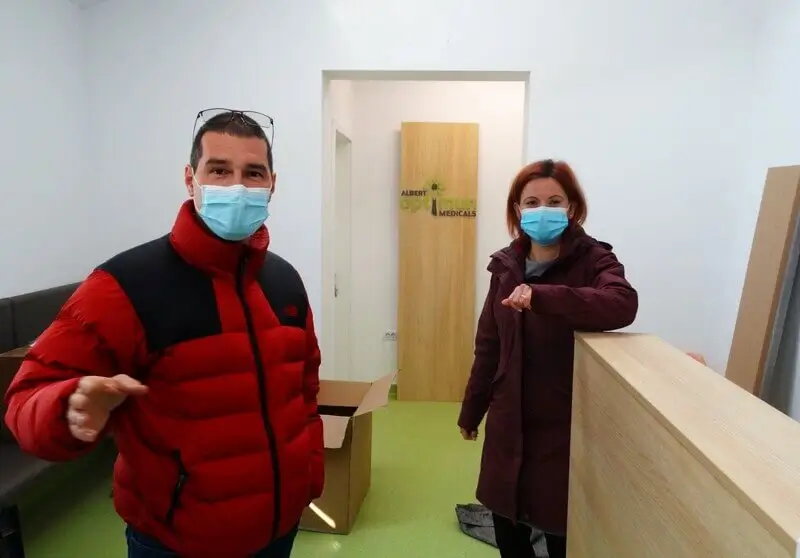
Ophthalmologist Dr. András Albert and his wife, dr. Allergist Albert Kinga decided four years ago that they wanted to continue their independent activities in their own clinic. This is how they embarked on the investment that created the first privately owned, full-fledged art block and clinic in Sepsiszentgyörgy on Bălcescu Street, the opening of which is planned for the end of November. Builders are putting the finishing touches on the Albert Optimun Medicals facility, and the furniture and medical equipment will soon be in place. We asked the doctor couple about what motivations made them continue in the almost four years from the birth of the idea to the realization of the total investment of around six million lei.
Professional advancement
Dr. Albert Kinga: In our profession, during continuous professional development, there is always a demand for a little better. We participate in a lot of training both at home and abroad, and the space at the location of the outpatient appointment has started to get small. In the case of ophthalmology care, this was even more pronounced than in my profession, since outpatient specialist care in Háromszék only covers diagnostics. What if we created a space where everything from diagnostics to surgery could be solved? we asked the question. And we did it.
Dr. Albert András: Everything that can be done in ophthalmology today can be done here. We have built an operating theater that meets all kinds of professional and licensing standards, with sterile air and the circulation system that is required. Thanks to the tender, we added a new wing to the old house, with ophthalmology diagnostics on the lower level and the operating room on the upper level. Since it was an EU tender, a series of requirements had to be met already when the plan was prepared. Not only from a professional point of view, but also from a financial point of view, since a deductible was required.
Dr. Albert Kinga: And if the old building was already available, by renovating it, we will be able to carry out allergology, immunology, cardiology-internal medicine, vascular surgery specialist consultations, and later - since we have space - pediatric surgery consultations.
Tender with bumps
Dr. Albert András: It is mandatory to prepare an implementation study before the application documentation. The simple thing, not for us, as we are doctors, but for the specialist companies. But since everyone here is only semi-professional - unfortunately, I have to put it this way - the implementation of the application was far from smooth. For the sake of success, we agreed to fulfill all conditions, which earned points in the assessment. For example, it was clear that we deal with the injured and the disadvantaged, we also use renewable energy, and pay attention to selective waste management, but something like the international promotion of the service is more difficult to implement. But we accepted that too. The application was successful, but during the implementation it was revealed that medical equipment worth one hundred thousand euros, which is essential for licensing and good operation, was left out of the appropriate budget. In a word, it is very complex to prepare such a tender, you have to be very careful not to miss big things and to put them in their place. But even after several studies, it was not possible to avoid these traps, and the specialist company did not help in this either. Not to mention the fact that the prices had slipped in the meantime, due to the changes in the construction industry, the costs had increased significantly, which could no longer be included in the tender. Then everything was not found on the design-execution line either, so the whole thing cost almost twice as much as the amount won in the tender. The road was bumpy because we undertook it together with construction, which means we had to deal with things outside of our profession. Thus, if I pay close attention, I can already install heating, I know how photovoltaic systems work. Speaking of renewable energy: we installed a ten-kilowatt panel system, but how To what extent this complements the need, we do not yet know, since it was a tender requirement that a so-called off-grid system must be implemented, so we can predictably use its capacity in the summer, if, for example, air conditioning is needed. Conventional energy could have been paid off for up to twenty years from the amount of the investment.
Dr. Albert Kinga: The paperwork wasn't always smooth either, it took a long time to get the permit and then the start of the investment. With all of this, we can see the end, we are planning the opening at the end of November, of course in compliance with the epidemiological regulations. For now, we have created five new jobs in addition to the existing ones, but we are also planning to expand later. So in retrospect, I can see that it was very easy to come up with, but it was all the more difficult to implement.
Dr. Albert András: There was a critical moment, when it turned out that a number of things were left out of the tender, and the prices ran out, then it was thought that we would abandon the implementation. Seeing the shortcomings, the tender preparation company also offered to waive its financial demands. It was a difficult decision, but we went ahead with it. But there were many smaller, but decisive things that caused difficulties. As it was a European Union tender, our idea of implementing a part with a local contractor did not work either. A positive example, however, is the prepared, helpful local construction team. At the same time, we would start again, since when we got over one of the obstacles, we also left the annoyances behind.
Dr. Albert Kinga: We learned a lot, and if we had to start over, we could avoid a lot of pitfalls. And the epidemic situation helped us in one thing, as the administration improved a lot. For tender documentation and accounting, it used to be necessary to have an almost complete printing press, but at least one separate copy machine in order to produce the huge amount of paper. This can now be done digitally.
Clinic
Dr. Albert András: From the idea to the implementation of the plan, we strove to solve every single ophthalmic intervention in an outpatient system. In other words, the patient does not need to be invested, which increases the speed and safety of the intervention. All of this in an operating room that meets the conditions of units operating in state hospitals in all respects, for example regarding sterility, surface area or cubic meters of air. Although from a professional point of view, ophthalmic surgery does not require as much space as, for example, an orthopedic one, the conditions to be met are the same. We can provide five specialist medical services at the same time, and we also have a sampling point. Of course, we will keep our contract with the health insurance company, so the services billed by it will be free of charge up to the funded amount.