Blurred vision, squint, eye exercises, vision correction
Dr. Albert András - Blurred vision, squint, eye exercises, vision correction
The awareness of a chronic, disabling illness is frustrating for every member of the family, every day.
In our modernly equipped ophthalmology clinic, it is possible to perform a painless, complex examination of the refractive error of young children and to solve the diagnosed cases. Most childhood vision problems can be corrected by wearing glasses.
The majority of vision defects themselves are genetically determined, that is, they can be inherited, the phenomenon of family accumulation is common.
In many countries, the diagnosis of amblyopia is exclusionary for occupations where the quality of vision is crucial. When the child grows up, he cannot become a professional driver, pilot an airplane, become a police officer or a professional soldier. Since the lazier eye loses its "seeing" function, it subsequently makes a different movement in the eye socket, i.e. the two eyes do not move in the same way - squint develops. In advanced cases, this can also be noticed by an outside observer, the child can become the target of teasing at school, it can cause anxiety, and periods of depression can occur as an adolescent. The typical fear of a parent of a visually impaired child is that the child may lose vision in the better-seeing eye (several ophthalmic or systemic diseases can lead to vision loss, diabetes, kidney problems, diseases affecting the immune system, trauma, accidents), and therefore often uses hyperprotective education. A child brought up in a shell, who is aware of his illness, has a harder time socializing and is more prone to depressive manifestations. It is our firm opinion that the rehabilitation of these visually impaired children would mean a chance for a fuller life for both the child and the entire family.
Our goal is to help children whose squint cannot be operated upon, and whose amblyopia cannot be corrected by wearing glasses. Cases recognized in time and treated with appropriate developmental practices in childhood are most likely reversible. In adulthood, unfortunately, it can no longer be improved at all, or only to a small extent. Until now, this vision re-learning process has been tried to be achieved by periodically covering the better-seeing eye, the development software we propose would offer a solution for those where only temporary or partial results were achieved by covering the eye, or where the covering could not be carried out.
The gluing method can be difficult to implement, it is difficult for younger children to tolerate having to cover their better-seeing eye for 1-4 hours a day for months, and in the case of older children, a feeling of shame in front of their peers may arise when using the method, and the parent is forced to constantly monitor it.
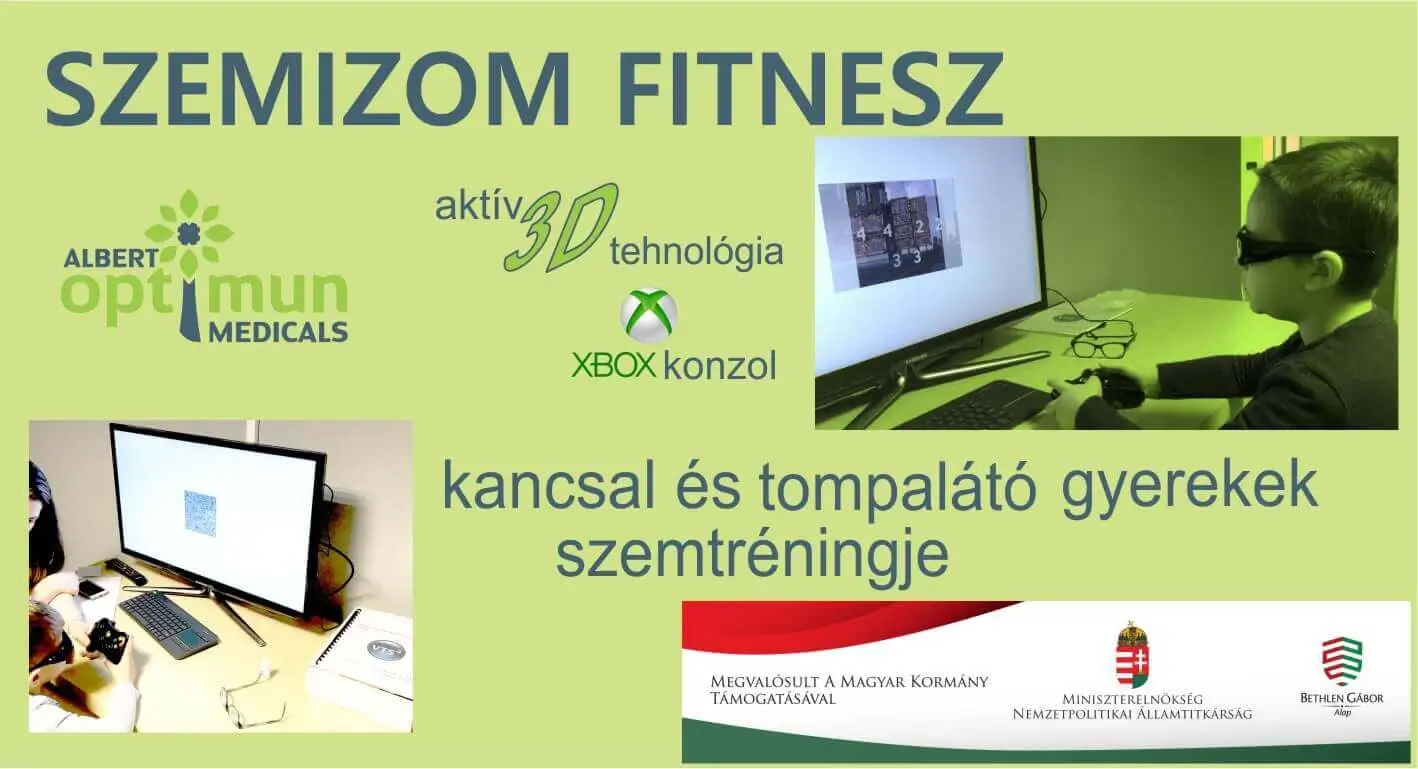
The development software we recommend is a computer-controlled video game-like program (with the help of active 3D technology and xbox console), it is easy to use for members of the Y and Z generations, families see controlled improvement sooner with a smaller investment of effort.
After the accurate diagnosis, the visual rehabilitation can consist of 2 parts, the first takes place in the doctor's office, the child participates in 10 consecutive 30-minute development sessions (video game-like, painless), the vision is checked at the end of the sessions, the improvement can be monitored, and then, as a second phase, the development can continue online at home. A complete treatment package results in an average 30-50% improvement in vision, depending on the age at which the child starts and what the underlying problem is.
From a professional point of view, we offer a truly healing alternative to the affected children, which has not been available to them until now. The system based on active 3D technology, which requires the child's conscious participation, has a different effect on the brain than the covering, penalizing, method (covering the better-seeing eye) used so far. The computer program prompts the brain to use both eyes to see, not just the right, so in effect the brain relearns to see with the worse eye and the squint is evened out.
The rehabilitation of the affected children is in progress, there are children who have already passed the masking method, in their case we would recommend the use of the software as an additional treatment, since (this practically encourages the weaker eyes to work), Those children for whom masking was not feasible, so they could not participate in the previous rehabilitation option, will get a new chance to improve their vision.
In the case of children with unilateral visual impairment, one eye takes over the other and the vision of the weaker eye becomes dull, the child gets used to it, it is natural for him, as he practically sees, and he does not recognize that he actually only has one eye. The vision problem is characterized by the fact that the process develops at a very young age, and if it is not accompanied by squinting, there is no external factor that draws the attention of the parent to the problem. Practically, by the time the child starts to speak or reaches the age where he could recognize and say that there is a problem with his vision, the blind eye has already developed and he is used to the condition. By the time you see that the two eyes are not moving together, the blurred vision has already subsided. A typical diagnostic age for amblyopia is starting school, when it turns out that only one eye can see. Even then, it is not too late to try to involve the lazy eye in vision, but the degree of improvement is obviously less than in early childhood.
Our method is painless, performed under the supervision of a specialist, short and the result is spectacular. The use of the computer program, which requires 3D glasses, is child-friendly, for visually impaired children coming out of the Y and Z generations, it is a close-up task, they like to do it, they think of it as a game. Since their vision is improving day by day, the child has a sense of success associated with the action, which improves his willingness to perform tasks at home as well.
Our goal is the visual rehabilitation of visually impaired children, to give them a chance for a fuller life. Our profession is medicine - we hope this can be exemplary for all people.
More information in the context of an ophthalmological examination.