A tale about the evil ragweed, who caused more trouble than we thought
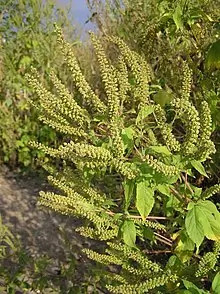
Details fit for a fairy tale
Where there was, where there wasn't, once upon a time, a few adventurous ragweed pollen (Ambrosia artemisiifolia) grain traveled a lot. He boarded a ship in the New World and then arrived at a European port. In order to protect the grains, they arrived fortunately and entered the ground together with the autumn sowing. There, they rested from the fatigue of the journey until spring, and at the same time as sowing, with renewed strength in the spring, the few pollen grains took root and gave birth to a green, lanky plant. At the end of summer, the new plants blossomed into lush, yellow spike-like flowers and shed pollen, which was picked up by the wind and carried several kilometers away and scattered all over the mowing fields and fallow fields. The pollen grains, now multiplied, returned to rest in the ground, but thanks to their hardy, resistant nature, they were not harmed by cold, frost or drought, and began to reproduce in the following years. Those pollen grains that got mixed up in cereal soil were not lucky, because most of them were removed at the same time as the harvest before they bloomed in August, but the ones that strayed into an abandoned, uncared-for area created plant colonies that happily multiplied in the summer heat. Being an undemanding plant, if it rained a lot, it grew cheerfully green, if there was a drought, other plants died, but its pollen remained in the soil for up to 80 years, switching to economy mode. Thus, in a few centuries, the wild grass became the king of the areas left fallow, displacing the previously native vegetation and dominating the weeds. Thanks to his old friend, the wind, he made it to the big city, where he unfortunately got into bad company and made friends with the exhaust gas. This made him much more reckless, biting, and a grumpy fighter. The many pollen grains landed on people's eyes, noses, and airways and began to sting and tickle them. People just cried they sneezed, their noses ran, some even coughed badly, but they didn't know why. They thought they had colds all the time, some noticed that their odd summer cold came back every year, but some didn't seem suspicious at all that every summer weekend caused more problems than the winter flu season. The real scare occurred when some children and adults had a summer cold replaced by a cough, difficulty breathing at night, a choking attack or a swollen face, burning eyes, and a runny nose. At that time, the population also began to suspect that they were dealing with a previously unknown enemy, and within a short time it became clear that the hay fever caused by ragweed pollen, which returns every year, prevents them from resting at night for weeks, because of this, adults and children are sleepless, cranky during the day, forced to take a lot of medication, they cannot perform properly at work, there are learning difficulties and the long-awaited vacation is overshadowed by constant sneezing. runny nose, lacrimation, itchy eyes, cough, suffocation at night. It has been observed that recurrent colds mainly affect young people, and the symptoms get worse every year. They were only really scared when it turned out that ragweed pollen allergy would most likely turn into asthma within a few years, and they rushed to grass and trees. It turned out that there is no escape, the more plants live freely, in the wild, the more pollen is in the air, and the more they live with them, the more likely they become sensitive to pollen. On the advice of the sages, they tried to take up the fight with the enemy traveling by air, to destroy and eradicate the plant that caused the galiba, but by then it had become a great lord, the king of the wastelands. The king decreed the extermination of wild grass, the untidy, eradication of neglected areas, but indifference prevailed among his subjects, and while some of the inhabitants denied the existence of the harmful weed, others knew about it, but did not deal with it, only the affected and suffering part of the population took the wise men's concerns seriously.
Our story that has been told so far, with a modern twist, the reader can write the ending of the story himself - freely choosing to make room in the coming years and decades - whether it is for the further expansion of ragweed or by placing the emphasis on prevention, by writing about the harmful weed we try to break the vicious cycle of pollen sensitization - hay fever - asthma. The choice is in the hands of the reader, indifference is not a solution, the happy ending is up to us. What is a problem these days is growing into a public health concern for our children and grandchildren, and we cannot turn back the wheel of time, we should act until we can successfully fight ragweed pollen.
The sad reality
- Hay fever caused by ragweed is a serious health problem in some areas of Europe and the United States of America.
- The seed of the ragwort is extremely resistant to environmental adversities, it can wait up to 80 years in the ground in an inactive state for a plant to develop from it.
- 1 blade of ragweed can produce a lot of pollen,
- Ragweed pollen grains can travel hundreds of kilometers thanks to the wind.
- Most of Hungary is affected by hay fever and asthma caused by ragweed pollen.
- In Romania, it causes serious problems in the mining areas and the lowlands and around the capital. According to statistical data, out of 9,000,000 active residents, approx. 485,000 people are registered with a ragweed pollen allergy, the active population represents 5.35%, which numerically rivals the prevalence of diabetes.
- In Transylvania, the climate in the bend of the Carpathians has so far been less favorable for the growth of the plant, but thanks to global warming, it is starting to spread in our country.
- In Romania, a government decree obliges the writing of ragweed.
- THE Romanian Society of Allergology and Clinical Immunology (RSACI) conducts an active campaign to make allergic diseases caused by ragweed (hay fever, asthma) more widely known and therefore more recognizable.
- The symptoms of ragweed allergy can be alleviated with medication, hay fever can be cured in many cases, and asthma can be moderated with allergen-specific immunotherapy.
- Domestic research proves that an allergy caused by neglected, untreated ragweed pollen turns into asthma in an average of 5 years. Unfortunately, due to the aggressiveness of the pollen, even the cases treated with medicine continue to get worse. There is a cure for the disease, but very few people use it (lack of a suitable specialist, patient indifference, financial problems, inappropriate doctor-patient relationship). Currently, allergen-specific immunotherapy is the only proven effective treatment that can stop the progression of the disease, eliminate the symptoms and reduce the need for medication. It is used on the recommendation and under the supervision of an allergist.
Dr. Albert Kinga allergist, Albert Optimun Medicals, Sepsiszentgyörgy, www.optimun.ro