A few thoughts about atopic dermatitis
Dr. Albert Kinga allergist, Albert Optimun Medicals, Sepsiszentgyörgy, www.optimun.ro
What does atopic dermatitis (atopic eczema) mean?
Atopic dermatitis is a chronic inflammation of the skin that is accompanied by dry skin, inflammation, intense itching and frequent flare-ups. Physical and emotional stress provokes the process, 10-15% of children under the age of 5 are affected. The incidence varies from country to country. The disease affects the quality of life to a great extent, and due to the aesthetic problems, it causes adjustment disorders and psychological stress for the patients.
What does atopic form mean?
Atopic dermatitis is a skin disease based on an inherited tendency (so-called atopic constitution), which most often appears in infancy or early childhood. By "atopic condition" we mean that the patient reacts to various external stimuli with itching and inflammation of the skin due to the lability of the body's defense system. In some cases, the immune system is pathologically overactive - allergic tendency - in other cases it does not react quickly and efficiently - this is the explanation for the secondary skin infections that are common in atopy patients.
The atopic form is not a disease in itself, but it can manifest as so-called in the form of atopic diseases. These include atopic dermatitis and certain respiratory diseases (chronic bronchitis, pulmonary asthma). Atopic diseases can also occur in association with each other.
How is the disease inherited?
The immune system is extremely complex, and its inheritance is also very complicated, so it may happen that there is no other known atopic patient in the family of a child with atopy, but allergic diseases are often found in parents and grandparents (hay fever, pulmonary asthma, dermatitis caused by metal or chemical sensitivity).
What triggers are known?
In addition to the inherited tendency, atopic diseases are significantly influenced by many environmental factors. Against substances with strong allergenic properties (e.g. cow's milk, egg whites) can develop hypersensitivity even in infancy, so it is advisable to avoid these until the child is at least one year old. Infectious diseases, persistently dry air, air pollution, passive smoking, prolonged or severe stress provoke the symptoms of the disease.
What are the age characteristics of the disease?
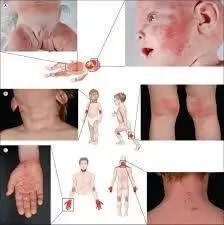
The skin symptoms of atopic dermatitis change with age, and based on this, we can distinguish 3 main forms: infantile, childhood and childhood and youth form. Dry skin and itching are constant symptoms of the disease.
Red, itchy, peeling spots appear primarily on the face and then on the trunk of an atopic baby, but it is also not uncommon for a skin rash consisting of moist dots on the face, which was mistakenly called breast milk rash in the past (since a healthy mother's milk does not cause any skin problems in her baby). We can often see a dry, flaky, sometimes yellowish deposit on the hairy scalp, which is also called dandruff in the vernacular.
From a young age, the symptoms appear more and more in the bends, typically in the bends of the knees and elbows, and on the neck, but redness and peeling of the skin of the face and eyelids are also common symptoms.
The symptoms gradually pass into the juvenile form, where, in addition to the chronic skin inflammation, the palms and soles are affected, as well as the strongly itchy, red nodules visible on the limbs.
Children's eczema therapy is complex, good cooperation between doctor, parent and child is essential for effective treatment.
What should we do if we find signs of atopic dermatitis in our child?
With the help of an allergist, the allergic background can be investigated. In roughly half of the cases, we detect a food or environmental allergen as a trigger-maintenance cause. If this is confirmed, a significant improvement can be expected with appropriate, targeted treatment and preventive measures. The treatment can be really successful if we know exactly what we are up against.
Finally, some myth-busting ideas for the everyday life of children with atopic skin
It is highly recommended to bathe every day, in not too hot water, for 15 minutes, you can add skin softening preparations to the bath water, after bathing, gently rinse off the water and then CREAM WITH BODY CARE FOR ATOPIC SKIN THAT TOUCHES THE WHOLE BODY. Babies and children with atopic dermatitis who are bathed every night and creamed with a drug-free body lotion sleep more peacefully and have fewer infections and skin complications. It is a common mistake that the parent only lubricates the child until the skin is ugly and only where he sees a change. Body care incorporated into the daily routine prevents the recurrence of the problem in the long term.
Dr. Albert Kinga allergist, Albert Optimun Medicals, Sepsiszentgyörgy, www.optimun.ro